Here is a cut-down version of the pilot TV episode I directed in central London. It is for a new TV show called 'My Dream Machines'.
My Dream Machines mini-pilot from neil horner on Vimeo.

Showing posts with label 7D. Show all posts
Showing posts with label 7D. Show all posts
Tuesday, 4 January 2011

Sunday, 1 August 2010
The best way to mount a camera to a car


Generally the lighter the camera, the more stable it will be with a minimum of support. Heavy cameras tend to need strong cheeseplate rigs that have multiple supports to brace from. They also need to be fairly level and so some extreme angles are a bit more tricky to achieve. But this cheeseplate from Filmtools has a full sized ball leveling head on it that is easy and quick to change the camera angle.

The biggest problem you need to combat when mounting a camera is bounce. You really need to try to brace the rig so that it is solid and does not have any movement in the camera and ultimately the image.

Suction cups always need a fairly flat and clean surface. Unfortunately, modern cars have a lot more curves and less flat surfaces, therefore, it is very useful to have a variety of differing suction cup sizes (4", 6" and 8" cups). This way you can now mount off small flat surfaces like the sills of the car or a spoiler and this opens up a greater possibility for camera positions and stability.


For a strong and solid mount, try not to brace off the bumpers of the car. Bumpers these days tend to be plastic and naturally are designed to have movement in them. In the past I have braced a camera off a bumper and as soon as the car hit a bump in the road, the camera wobbled violently and made the image unusable. It is OK to use bumpers for additional support to the main brace, but don't use as you main fix points.
I have been using the Canon 7D to film most of the car work as it is small, light and very flexible to put in most positions. Using the 7D is great, but if you don't mount a solid grip then you will get the 'jello effect' that has been so widely documented. This is even more important if you are mounting a bonnet camera because as soon as you start the engine, you have a lot of vibration that transcends into the image sensor of the camera and that can completely ruin the footage. Its another reason that I favour the 7D over the 5D mark 2 for this type of work. The 5D has a slightly larger image sensor and therefore is slightly more unstable when it comes to vibration in the sensor - and these cameras are subject to quite a bit of turbulence and vibration when driving at speed off the side of a car and an uneven surface.

Recently I mounted a bonnet cam on a chase car in order to film the new Fabia Vrs from the rear. I had always favoured a tripod mount that triangulates a solid footprint, because I had always thought that this was the best and most secure way to rig the camera.


For suction kits, Filmtools.com has superior mounting equipment and pretty much everything you will ever need. However, the shipping costs can be high as the equipment tends to be fairly heavy, so always check first. A good UK based alternative is Cameragrip.co.uk , but their range is a little more limited and not as adaptable.
Monday, 17 May 2010
Nissan 370Z roadster shoot with Canon 7D

I recently filmed the new Nissan 370Z roadster. It was shot over two days and three separate locations with the Canon 7D.
On the first day the car was shot in Spanhoe airfield in Laxton. We filmed in an old aircraft hanger which was a great location to start with, but naturally a little dark.

Of course you will need a monitor for playback to see the noise. The small viewfinder on the back of the camera is not capable of showing detailed noise and so if it looks good on the back of the camera, it des not necessarily mean you won't find noise on the image when you get it back to the studio. There is nothing worse than getting it back and seeing that the image is not usable.
However, if you get the balanced settings correct in low level light then the image will look great with minimal lighting budget and costs.

The Second location was still in Laxton near to a fantastic viaduct, which gave us some great images.


On the second day we filmed in Chobham near to a National trust reserve and just off the motorway. It was a great location, but again I noticed a fair bit of the 'jelly' effect that the HDLSRs are known for.
The roads where not perfectly smooth and so whenever the car bounced over a bump, it then had an exaggerated effect on the camera.

I don't feel like I would be confident to direct a film on the Canon that entailed a lot of motion or traversing of the camera. I could happily live with the noise issue and just add some extra lighting to counter it...but the jelly effect is something I don't think I could ever get use to.


Thursday, 22 April 2010
Microsoft car shoot


This was the first test shoot with the new Canon 7D rigged for film and so I was quite excited to see how it would perform under extreme conditions.
Usually when filming at speed you get a lot of vibration which makes the images distort. On this particular shoot the 7D was fine and I was impressed by how the image was not affected when I used the stabiliser on the zoom lens. If you are using prime lenses with no stabiliser then expect some vibration. More recently I shot a bonnet mount on the new Audi A4 and I used a nice 24mm Carl Zeiss 2.8f prime lens to get a nice depth of field, but the vibration from the engine alone was enough to cause problems with the image. There have been lots of reports about the HDSLRs having a 'jelly' effect on the image sensor when the camera is shaken about and this was certainly the case with the A4 shoot. Therefore I would recommend that you sacrifice the depth of field and use a lens with a built in stabiliser.
Overall the 7D performed way above my expectations and you only really notice that when you are looking at the rushes. It allowed some great 50fps footage to be shot and again this helps in the edit to slow down any bounce. In fact the only problem I really had was the lousy weather.

When you are shooting low angle out the back of a moving vehicle at speed and on a wet surface, you have a very limited amount of time before your lens is covered in gunk and water. So you are constantly wasting time cleaning the camera and the lens. A few solutions to this are to drive slower or move to a country where it doesn't rain for ten months of the year!
The only other thing that the 7D needs is a monitor. The viewfinder at the back is a great feature and as it has a live mode it allows you to point and see what you are shooting. However, the viewfinder is only a guide and while the images may look sharp on it, once you get it back to the studio, they may have been soft - and that's upsetting!
Of course the viewfinder is on the back of the camera so if you have the camera out the back of a moving car, then your head has to physically be behind it to see it, which can be impossible or even dangerous in some situations.
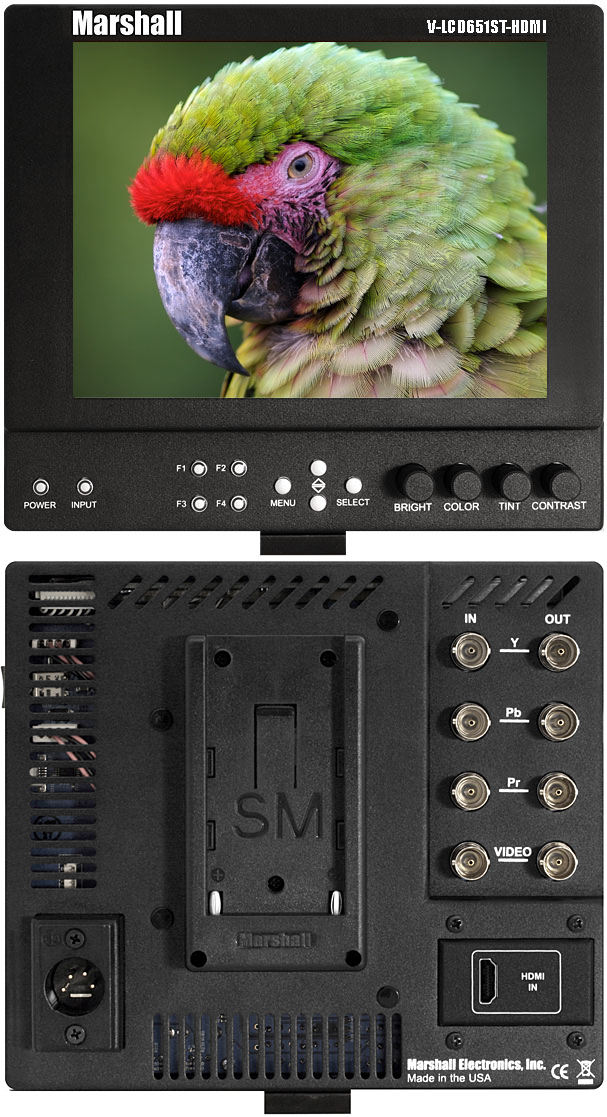
The solution to all this is an external monitor like the Marshall V-LCD651ST-HDMI. It has a 1024x768 resolution and can easily connect to the hot shoe of the Canon that allows it to be positioned in any direction. But more importantly it has an in-focus filter that actually allows you to see when your image is in focus or soft. It also has an exposure filter that allows you to see if the subject is correctly exposed. It has great playback in a higher res than the viewfinder with an anti reflection screen. In short this should be the answer to most of the problems I came across on the shoot...that and a nice spell of sun!
Subscribe to:
Posts (Atom)