With the 'game changing' introduction of DSLRs, it has made it possible for anyone to pick up a relatively cheap camera and shoot some high quality footage. It is something that would not have been possible a few years back without access to an expensive camera or biting the bullet on the camera hire costs.
I have heard a few people recently complaining that now 'anyone' can pick up a camera, point & shoot, 'it has saturate the market with wannabe film makers'. It has given amateurs the access they needed to think they could possibly be professional (how dare they?). It has meant they have improved the quality of their work and now could be considering a career in film making...(a market that is notoriously over stretched with people trying to 'make it' and does it really need to be stretched any further?).
Experience is everything in this game, the more experience you can get playing with a camera by yourself, the better you will be at knowing what works and what doesn't! How else can you learn?
In my opinion, you have to commend ANYONE who has the notion to pick up a camera and decide to give it a go. We need more of this attitude. People generally don't understand just how much work is really involved in making a film (I don't even mean making a good film...I mean 'any' film). It is so difficult just to keep focus on the story and try to control everything that is going on in a sequence, while staying on schedule and budget that anyone who gives this a go should be congratulated and not put down.
Its far too easy to tear strip off other people when you are not performing well yourself. If you are on of those who believe the world owes you a living and any new comers trying to become directors are just ruining your own chances, then I would suggest that you are exactly the type of person you are complaining about...YOU are saturating the market!
Be proactive, push yourself further and stop worrying about what everyone else is doing. Have your own game plan and go for it! Contrary to popular belief, not every director has made it because of their industry connections, but because of their hard work, unshakable commitment and ultimately...talent!
This country is starting to realise that it can produce independent films of such quality that they can rival the big film studios. And this can be done while flying in the face of economic strife and even while the UK film council is in dire trouble...there are always talented people out there willing to pick up a camera and learn the craft. That has to be admired in my view, because this is exactly the type of passion and stubbornness that you need to make a film in the first place. Can you imagine if Spielberg had never bothered to pick up a camera?
All these new people now trying something that they were not previously able to try will naturally mean a more saturated industry. But it will also mean that current directors will have to try harder, push boundaries further, be more experimental and creative than ever before...just to try and stay ahead. The wolf climbing the hill is not as hungry as the wolf on top of the hill. Ultimately it will make for a much stronger UK film industry and that can only be a good thing right now.

Tuesday, 23 November 2010

Wednesday, 22 September 2010
Resonance is a big hit at the London Film and Comic Con

LFCC takes place every summer at Earls Court 2 in London. It celebrating the best of film, television, comics and sport. It is a huge arena that pulls in vast crowds and has many celebrities that make appearances over the weekend.

This year there were some great names from the sci-fi film world, including William Shatner (Star Trek), Edi Gathegi (Twilight), Sean Young (Blade Runner), Sean Pertwee (Event Horizon), Ben Browder (Farscape) and many more. Mike Tyson was even there making an appearance after his role on 'The Hangover', so it was an event that was very popular for all ages and all types of fans.
My favourite appearance of the weekend had to be the impressive tumbler batmobile from Chris Nolans' latest batman movies. This proved to be a real crowd-pleaser and I was able to take a crowd free snap just before the comic con opened and the tumbler was swamped with people.

This was the first time I had ever been to a Comic convention and it was a really great and unique event. Everyone was in great spirits and there would be unexpected visual feasts at every corner as a comic book hero would suddenly emerge in fully custom made costumes.


The day was fairly relaxed and consisted of shooting some time-lapse photography of the set-up stage of the arena. Then filming some interview style pieces to cam with the shows' creators and core team.

The pilot was very well received by the fans and the big question on everyone's lips was when are they going to get to see more, more, more. When fans are dying to see more of a great story...you know you have a great production.
Here is the video we filmed on location at the London Film and Comic Con.
http://www.willyouhelp.co.uk/
Sunday, 1 August 2010
The best way to mount a camera to a car


Generally the lighter the camera, the more stable it will be with a minimum of support. Heavy cameras tend to need strong cheeseplate rigs that have multiple supports to brace from. They also need to be fairly level and so some extreme angles are a bit more tricky to achieve. But this cheeseplate from Filmtools has a full sized ball leveling head on it that is easy and quick to change the camera angle.

The biggest problem you need to combat when mounting a camera is bounce. You really need to try to brace the rig so that it is solid and does not have any movement in the camera and ultimately the image.

Suction cups always need a fairly flat and clean surface. Unfortunately, modern cars have a lot more curves and less flat surfaces, therefore, it is very useful to have a variety of differing suction cup sizes (4", 6" and 8" cups). This way you can now mount off small flat surfaces like the sills of the car or a spoiler and this opens up a greater possibility for camera positions and stability.


For a strong and solid mount, try not to brace off the bumpers of the car. Bumpers these days tend to be plastic and naturally are designed to have movement in them. In the past I have braced a camera off a bumper and as soon as the car hit a bump in the road, the camera wobbled violently and made the image unusable. It is OK to use bumpers for additional support to the main brace, but don't use as you main fix points.
I have been using the Canon 7D to film most of the car work as it is small, light and very flexible to put in most positions. Using the 7D is great, but if you don't mount a solid grip then you will get the 'jello effect' that has been so widely documented. This is even more important if you are mounting a bonnet camera because as soon as you start the engine, you have a lot of vibration that transcends into the image sensor of the camera and that can completely ruin the footage. Its another reason that I favour the 7D over the 5D mark 2 for this type of work. The 5D has a slightly larger image sensor and therefore is slightly more unstable when it comes to vibration in the sensor - and these cameras are subject to quite a bit of turbulence and vibration when driving at speed off the side of a car and an uneven surface.

Recently I mounted a bonnet cam on a chase car in order to film the new Fabia Vrs from the rear. I had always favoured a tripod mount that triangulates a solid footprint, because I had always thought that this was the best and most secure way to rig the camera.


For suction kits, Filmtools.com has superior mounting equipment and pretty much everything you will ever need. However, the shipping costs can be high as the equipment tends to be fairly heavy, so always check first. A good UK based alternative is Cameragrip.co.uk , but their range is a little more limited and not as adaptable.
Monday, 26 July 2010
It's a bug's life
It was a rather sunny weekend last weekend and so I decided that I would head off into the wilderness to try and photograph some insects...after all, how hard can it be?

The first thing I noticed was that while you expect to see wildlife everywhere, it is actually quite difficult to spot it and so you have to uber-concentrate in order to spy a potential wee beastie. Once I had spotted a little critter, I quickly hurried over with my heavy footed size 10s and whatever it was that was lurking there, quickly disappeared into the long grass. This happened over and over and an hour in without a single photograph was starting to become frustrating. Therefore, I would have to become one with the world and dust off my ninja skills...'crouching Neil, hidden dragonfly'.

I had been chasing a butterfly for quite some time, but trying to get a photo of one was proving near impossible for me...but I did get close...ish!

OK, this wasn't going into National Geographic, so I decided that the quick moving and shy insects were too well adept to spotting me. So I would pick off some slow moving bugs if I could find them and gradually improve my skill at sneaking up on them.

So I managed to sneak up on one of the slowest I could find! :) This little fella didn't have much choice about being photographed! If I couldn't shoot a butterfly, I would shoot one before it became a butterfly!
The problem was that to get any decent close up images of bugs, means you need to shoot with a macro lens, this in turn means you need to get fairly close to the subject in order to photograph it...this is the point that they usually scurry/fly away.

The second problem with shooting a macro image is that you have a really shallow depth of field. It is so shallow that the front end of a bug can be in focus while the back end is out of focus. Now add in a multitude of variables like the wind blowing the grass reed that the bug is sat on, your breathing while holding the camera, the bug moving, bad balance while crouching, and you will end up with a soft image on the focal point. This is a real pain when you might only get one chance to photograph it before it hops off from the sound of the camera click.
After a lot of missed opportunities and many out of focus shots, I started to become a bit better at creeping up on the creepy crawlies and so I managed to get a few nice shots for my efforts.


I should also mention the light issue here as well. Flying bugs tend to move at a very fast rate, especially their wings. The common bee can beat it's wings up to 180 times per second, so if you want to capture it in mid-flight, then you really need to have a camera that can shoot at extremely high shutter speeds...if you don't, then the wings will have a blurred look to them.


So, if you set up your camera with a high shutter speed, it means you are letting less light in through the camera lens and therefore you will have a darker image. This was especially true for shooting insect life as they tend to congregate in shaded areas under camouflage and in tall grass where they feel protected, this naturally means they are dwelling in areas with less light. I was quite fortunate as it was a really bright sunny day, but I think I would have struggled to get the level I got on an overcast day.
After a while I started to capture the really fast and twitchy type of bugs I had been striving for, and here are the results.


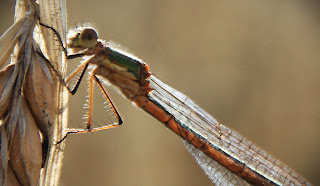


Ultimately shooting insects turns out to be a really difficult thing to do properly and it was a real eye opener for me. However, it was a great exercise in shooting a different subject and having to think your feet and tread lightly at the same time. I would recommend anyone doing this who is interested in photography or cinematography, after all, all you need is a camera, great outdoors and a bit of patience.

The first thing I noticed was that while you expect to see wildlife everywhere, it is actually quite difficult to spot it and so you have to uber-concentrate in order to spy a potential wee beastie. Once I had spotted a little critter, I quickly hurried over with my heavy footed size 10s and whatever it was that was lurking there, quickly disappeared into the long grass. This happened over and over and an hour in without a single photograph was starting to become frustrating. Therefore, I would have to become one with the world and dust off my ninja skills...'crouching Neil, hidden dragonfly'.

I had been chasing a butterfly for quite some time, but trying to get a photo of one was proving near impossible for me...but I did get close...ish!

OK, this wasn't going into National Geographic, so I decided that the quick moving and shy insects were too well adept to spotting me. So I would pick off some slow moving bugs if I could find them and gradually improve my skill at sneaking up on them.

So I managed to sneak up on one of the slowest I could find! :) This little fella didn't have much choice about being photographed! If I couldn't shoot a butterfly, I would shoot one before it became a butterfly!
The problem was that to get any decent close up images of bugs, means you need to shoot with a macro lens, this in turn means you need to get fairly close to the subject in order to photograph it...this is the point that they usually scurry/fly away.

The second problem with shooting a macro image is that you have a really shallow depth of field. It is so shallow that the front end of a bug can be in focus while the back end is out of focus. Now add in a multitude of variables like the wind blowing the grass reed that the bug is sat on, your breathing while holding the camera, the bug moving, bad balance while crouching, and you will end up with a soft image on the focal point. This is a real pain when you might only get one chance to photograph it before it hops off from the sound of the camera click.
After a lot of missed opportunities and many out of focus shots, I started to become a bit better at creeping up on the creepy crawlies and so I managed to get a few nice shots for my efforts.


I should also mention the light issue here as well. Flying bugs tend to move at a very fast rate, especially their wings. The common bee can beat it's wings up to 180 times per second, so if you want to capture it in mid-flight, then you really need to have a camera that can shoot at extremely high shutter speeds...if you don't, then the wings will have a blurred look to them.


After a while I started to capture the really fast and twitchy type of bugs I had been striving for, and here are the results.


Ultimately shooting insects turns out to be a really difficult thing to do properly and it was a real eye opener for me. However, it was a great exercise in shooting a different subject and having to think your feet and tread lightly at the same time. I would recommend anyone doing this who is interested in photography or cinematography, after all, all you need is a camera, great outdoors and a bit of patience.
Subscribe to:
Posts (Atom)